
Bombay Display Board: Colonials


The text, images and references of the 'Colonials' column as featured on the Bombay display board at Bombay Reserve.
In late 1821, the first European explorers - William Kearns, William Packer and Henry Marsh - set foot in the district. With an Aboriginal guide, they crossed the Gourock Range and Shoalhaven River, camping on the Gillamatong or Jembaicumbene creeks at a place called ‘Kirnly’ on 7 February 1822. They reported the country as rich grassland, thinly wooded and abundant in kangaroos and emus.
Surveyors followed the explorers and land grants were given to colonial settlers from 1825, particularly to military officers. In 1827, some twelve years before Braidwood existed, ‘Bombay’ featured as a locality on the earliest map by the surveyor, Robert Hoddle. The name ‘Bombay’ was thought to be adopted from Aboriginal word ‘bomba’ meaning big. A directory from 1832 also mentions ‘Bombay’ as a locality on the ‘Great South Road’ that ran from Bungonia to Krawarree, along the western side of the Shoalhaven River.

Map of Bombay marked on the ‘Great South Road’ in 1833.
Credit: Baldwin & Cradock
During the 1820s-30s, early settlers with large land holdings could apply for convict servants. Convicts were an essential part of the district labour force, clearing land and building infrastructure, at times outnumbering settlers 2 to 1. Convict transportation ceased around 1840 and more settlers and squatters took up land in the region during the gold rush. Mixed farming practices emerged, including cattle,
sheep and wheat.
From 1871-1928 the population around Bombay supported a local school. The first school was officially named Bombay Crossing, then “Bombay Half-Time School” or “Bombay Provisional School” and was located on the eastern side of the Shoalhaven, north of Bombay Road. A story from 1884 tells of local teacher, Miss Jessie Cunningham, courageously saving a pupil named Gifford from drowning in a
nearby creek. All the more miraculous given it was her first attempt at swimming!
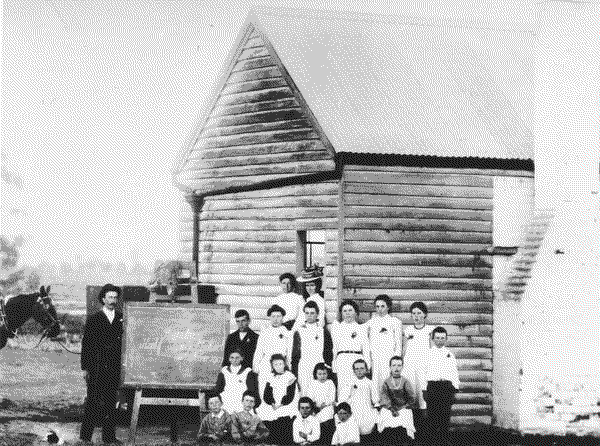
Bombay Half Time School in November 1907.
Credit: Braidwood Central School Archives
Gold mining and cropping declined by the early 20th century, and grazing, rabbit trapping, saw-milling and eucalyptus oil distilling were established. Woodlands of narrow and broad-leaved peppermints were heavily exploited (Eucalyptus dives and radiata). Many of the trees still show signs of being cut back to stimulate growth for oil production, with evidence of old boilers and distilleries scattered around Bombay. By 1967 the main distillery at Braidwood was producing 22,000 gallons of eucalyptus oil per annum, valued around $100,000 at
the time.
In the 1970s, plantations of Pinus radiata were established, with around 1300 acres planted locally. Many plantations were either burnt or logged after the 2019-20 bushfires, with only a few small stands of pines remaining. Today, Bombay is still a rural area, comprising both large and small holdings, mostly privately-owned.
< Previous Column First Nations or Next Column Glorious >
Colonials References:
- Gunn, R H et al. 1969, Lands of Queanbeyan-Shoalhaven Area, ACT and NSW, retrieved 28 August 2024 from <https://www.publish.csiro.au/CR/pdf/LRS24>
- Trove, National Library of Australia, 24 Apr 1884 Goulburn Evening Penny Post <https://trove.nla.gov.au/newspaper/page/9756084>
- Trove, 2024, Digitised Newspapers and Gazettes in Trove, retrieved 25 October 2024 from <https://trove.nla.gov.au/newspaper/about>.
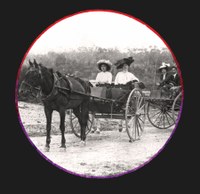
- Header Image Credit: Maud & Dolly Nomchong with Sydney friends in sulkies on the Bombay Bridge outside Braidwood. The beautiful waterhole near the bridge is still a popular swimming spot with locals. Braidwood and District Historical Society & Nomchong Family Photograph Collection, National Library of Australia, The Nomchong family at Bombay, Shoalhaven River, via Braidwood, New South Wales, ca. 1914 (Item PIC/7659/6) - Piece PIC Box PS 16308 #PIC/7659/6. Title and names of family members written on verso, including: '1. Maud Nomchong (daughter of NG Chee Dock), 2. Maud Shing (Elder sister of Ellen), 3. Dolly Nomchong (daughter of NG Chee Dock), 4. Ellen Shing (wife of W.J. Nomchong)'.
- "Bombay School in the School history database search". New South Wales Department of Education. Retrieved 19 January 2018.



This Bombay Landcare Information Board project was proudly co-funded by Bendigo Community Bank Braidwood, WaterNSW
Bombay Landcare Group and Upper Shoalhaven Landcare Council. With Special thanks to Sheep Station Creek Landcare's Christine Payne and Michael Gill for illustrations and design. Artwork © 2025 C Payne & M Gill. All rights reserved.