
Bombay Display Board: Fauna


The text, images and references of the 'Fauna' column as featured on the Bombay display board at Bombay Reserve.
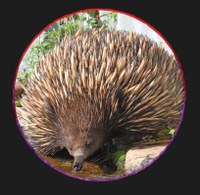
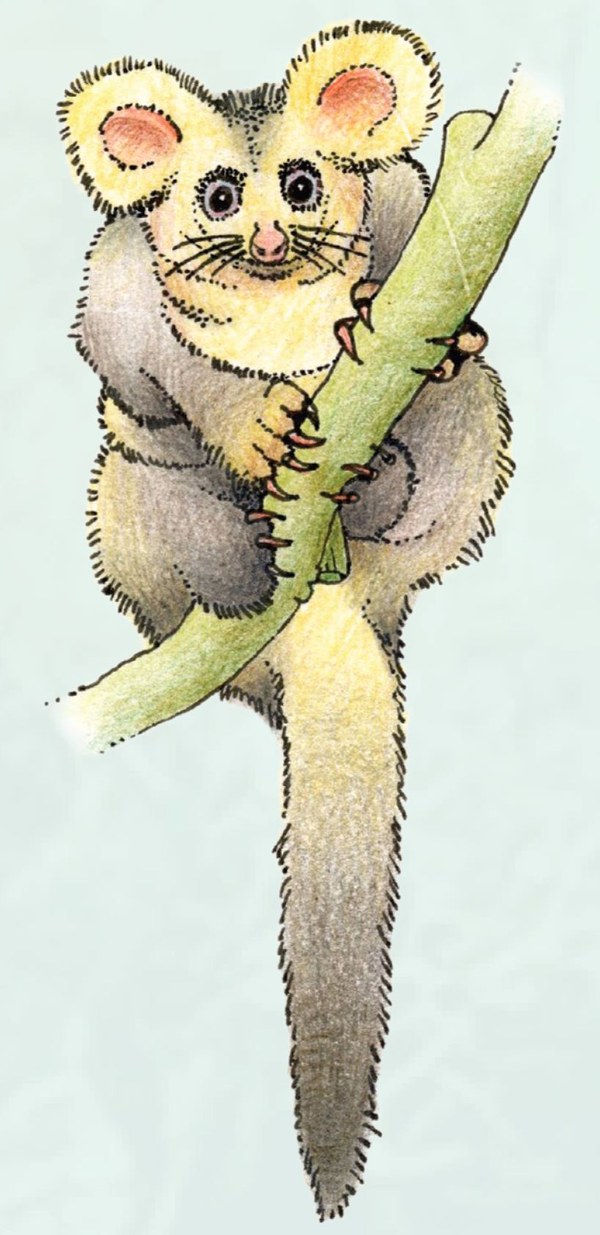
Greater Gliders (Petauroides volans or ‘banggu’ in Dhurga language) are Australia’s largest gliding marsupial. Once common throughout eastern Australia, the species is now endangered. Gliders are nocturnal and rely on hollows in old growth “den trees” to live and rear their young. The forests of the Tallaganda range to the west of Bombay are one of the few remaining strongholds, although logging still poses a risk.
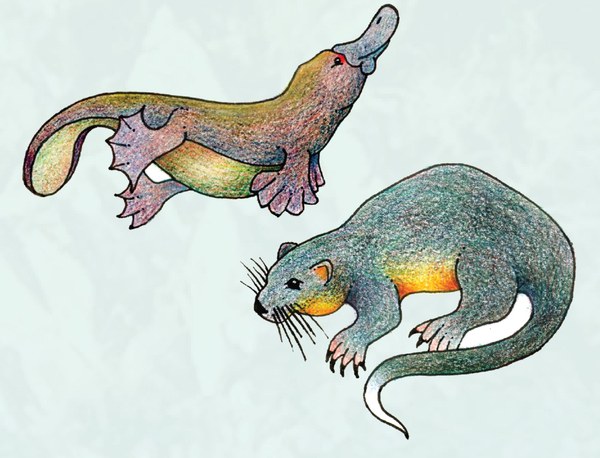
Platypus (Ornithorhynchus anatinus or ‘yaranbul’ in Dhurga language) and Rakali (Hydromys chrysogaster) can often be spotted along the Shoalhaven River at Bombay. These mammals are mainly nocturnal and can best be seen during the early morning and late evening.
Both species usually forage underwater. Platypus sift through the sediments of the riverbed, filling their cheek pouches with unchewed larvae and crustaceans. After foraging they rest on the water surface to grind and swallow their food. Rakali are less selective hunters, scavenging fish, insects, mussels, even turtles, birds and their eggs.
Rakali are the largest of Australia’s native rodents. Once known as the ‘water rat’, they have a distinctive white-tipped tail and are similar to otters, with webbed feet, a rudder-like tail and water repellent fur.
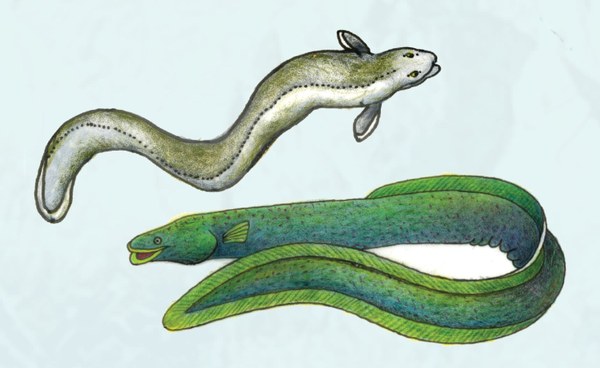
Native Short and Long-finned Eels (Anguilla spp.) can be found in the Shoalhaven River. They have an incredible life-cycle, with mature adults believed to migrate thousands of kilometres to spawn somewhere in the Coral Sea off North Queensland. The immature eels then migrate back to their fresh water river systems, swimming back upstream where they may remain for decades, before returning to their marine spawning grounds to breed and die.
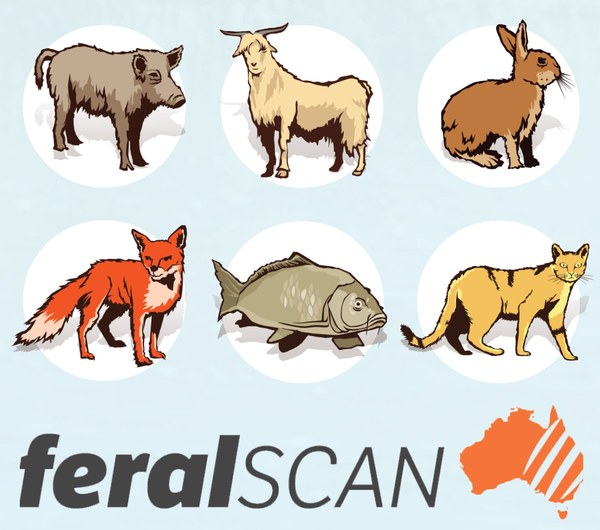
Feral animals pose serious biosecurity risks and negatively impact our native biodiversity. Common pest species around Bombay include herbivores like rabbits and deer, predators like cats and foxes, and omnivores like pigs. Carp are another riverine pest impacting aquatic species in the Shoalhaven. They have no natural predators and their destructive bottom-feeding habits contribute to turbidity and lower water quality.
Any sightings of feral animals can be reported on the FeralScan app or website feralscan.org.au.
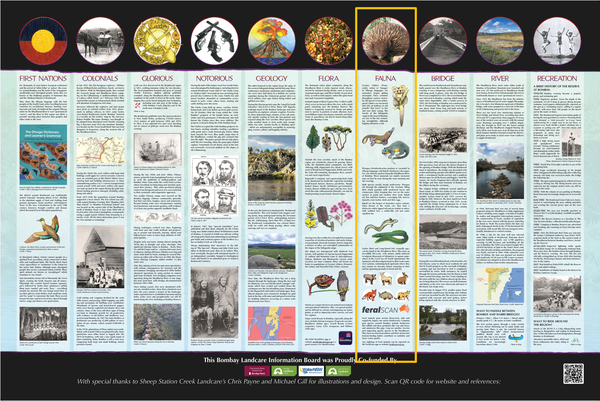
< Previous Column Flora or Next Column Bridge >
References:
- Special thanks to Peter West at FeralScan for consulting and suppling images and logos to the Bombay Landcare display board project. Peter is the FeralScan Coordinator with the NSW Department of Primary Industries and Regional Development Vertebrate Pest Research Unit, 1447 Forest Road, Orange NSW 2800
- FeralScan 2009-2025, feralSCAN: Record pest animal activity in your local area to protect farms, biodiversity and communities, retrieved November 2024 from <https://www.feralscan.org.au/>
-
NSW Department of Primary Industries – www.dpi.nsw.gov.au
-
NSW Local Land Services – www.lls.nsw.gov.au
-
QPRC – www.qprc.nsw.gov.au
-
NSW Government – Environment and Heritage




This Bombay Landcare Information Board project was proudly co-funded by Bendigo Community Bank Braidwood, WaterNSW
Bombay Landcare Group and Upper Shoalhaven Landcare Council. With Special thanks to Sheep Station Creek Landcare's Christine Payne and Michael Gill for illustrations and design. Artwork © 2025 C Payne & M Gill. All rights reserved.