
A day of learning, connection, and inspiration at Scholfield’s TSR


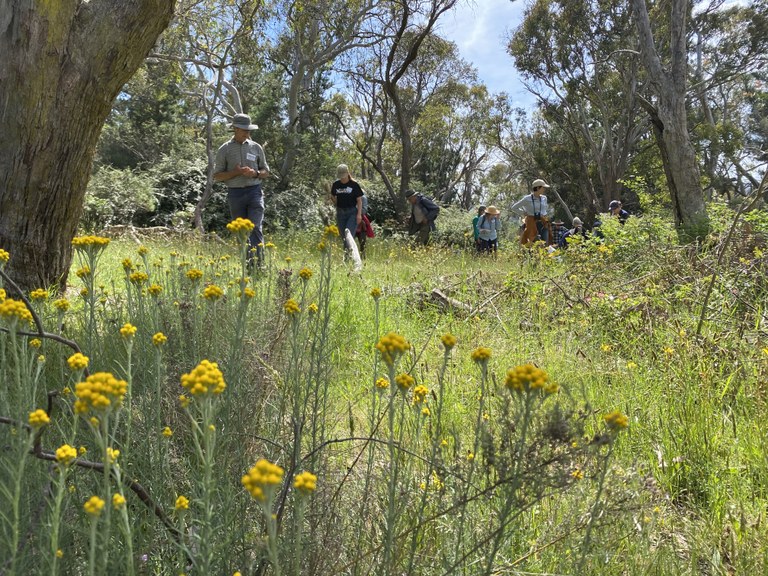
On Saturday 15 November, many Landcarers and community members turned out for the popular Below Our Knees: Exploring Our Native Grasslands workshop, held at Scholfield’s Travelling Stock Reserve (TSR) near Bywong. Jointly hosted by the Yass Area Network of Landcare Groups (YAN) and the Upper Shoalhaven Landcare Council, the workshop brought together experts, local Landcarers, and curious community members to learn more about managing and restoring our native grasslands.
Understanding the value of native grasslands
The day began with Friends of Grasslands (FOG) ecologist Sue McIntyre, who introduced the group to the ecology, value, and management needs of native grasslands. Sue emphasised one crucial rule: don’t fertilise. Native grasslands thrive in low-nutrient environments, and where past fertiliser use or pasture improvement has occurred, it can take decades for nutrient levels to drop enough for native species to return.
But the long wait is worth it—many native grassland plants are hardy perennials that offer year-round groundcover, productive grazing, rich biodiversity, and habitat for insects, birds, and a wider ecosystem, all while requiring very little intervention.
Sue also explained how weeds often invade grasslands via runoff lines, where both nutrients and seeds accumulate. While small-scale erosion can create opportunities for native species to establish, more severe erosion tends to favour exotic annual weeds. Maintaining groundcover and slowing water movement, using logs or other small interventions can make a significant difference.
Restoring native grasslands, Sue reminded everyone, is a long game requiring patience, consistency, and strategic weed (and sometimes regenerating native tree) management. Allowing native groundcover species to spread naturally, or assisting them through targeted planting, can slowly shift degraded areas back toward ecological resilience.

Exploring the reserve
The group then toured the TSR with FOG members Sue, Margaret Ning, and David Johnson, who pointed out species of interest and shared insights into native and exotic ground covers, including look-alikes like plantain. Native wildflowers in full bloom on the day included Ajuga australia (Australian Bugle), Chrysocephalum semipapposum (Clustered Everlasting Daisy), and swathes of Bulbine bulbosa (Bulbine lillies). Participants enjoyed hands-on plant identification and lively discussion among the grasses.

Weed identification and management
Following the Friends of Grasslands walk, South East Local Land Services officers Bella Hart and Alicia Kaylock led a practical session on weed identification and control within grassland ecosystems, supported by Neville Plumb Queanbeyan-Palerang Biosecurity Weeds Officer. They covered key strategies for managing blackberry - choosing the right herbicide, timing treatments, and considering factors such as residual effects on nearby plants and what is practical to achieve with consistent effort.
Weed ID and control methods were also discussed for serrated tussock, African lovegrass, and St John’s wort. The message was clear: consistency is the key. Even simple tools can be powerful and sometimes nothing beats a good old-fashioned hoe.
Learning the history of Scholfield’s Reserve
David McDonald from the local Geary’s Gap/Wamboin Landcare Group shared a fascinating history of the TSR, including the origins of the Scholfield name and how the reserve once formed part of a much larger protected area.

Collaboration and community: tackling weeds together
The group then moved to the Bywong Community Hall to hear from Dr Sonia Graham from the University of Wollongong. Sonia presented her recent research on how Landcare groups work together to tackle weed issues across landscapes. Her key case study was Towamba Valley Landcare, who’ve worked for years on the goal of not letting a single serrated tussock go to seed to great effect.
Sonia also highlighted approaches that lead to community weed control success, including:
- Defining a clear geographic area
- Setting achievable goals
- Assigning tasks based on people’s strengths
- Involving the whole community—from landholders to government agencies
Beyond the environmental outcomes, Sonia also spoke about the powerful social benefits of a community group approach - reducing isolation, building emotional support, and forging new friendships among neighbours.
Local connections and next steps
After Sonia’s presentation, participants broke into smaller, geographic-specific groups to introduce themselves, discuss weed issues important to their local area, and share ideas. Conversations continued over lunch, strengthening connections and sparking enthusiasm for future collaborations.
As a follow-on from the workshop, YAN and our partners hope to support interested groups to connect and work together on native grassland and weed issues and activities they care about. If you’d like to get involved—or simply learn more—please reach out to your local Landcare group or coordinator.

Get in touch
Gearys Gap / Wamboin Landcare
ggw.landcare@gmail.com
@Gearys Gap/Wamboin Landcare Group
Yass Area Network of Landcare Groups
coordinator@yan.org.au
@Yass Area Network of Landcare Groups - YAN
Upper Shoalhaven Landcare Council
upper.shoalhaven@gmail.com
